When most people say solitaire they mean Klondike: seven columns of cards, a draw pile, and four piles to build from Ace to King. The rules take a minute to learn, yet the game has enough depth that careful players win far more often than careless ones using the same deals. This guide explains the setup and every legal move, then gets into the decisions that actually change your win rate.
Our picks — play them free
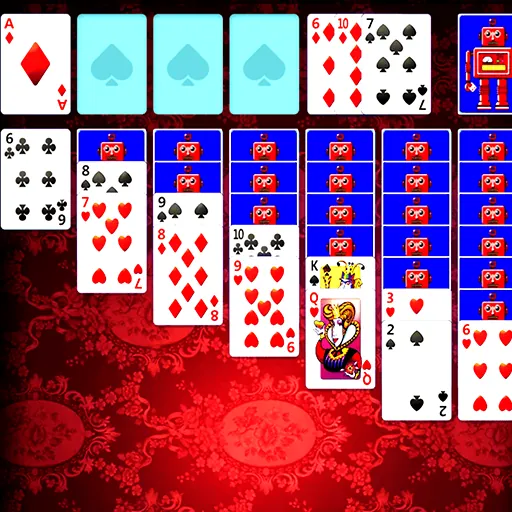


The solitaire layout
Klondike uses one standard 52-card deck with no jokers. The table has four areas, and knowing their names makes every other rule easier to follow.
- Tableau: seven columns holding 28 cards. The first column has one card, the second two, up to seven in the last. Only the top card of each starts face up.
- Stock: the remaining 24 cards, face down, which you draw from when you need new options.
- Waste: the face-up pile where drawn cards land. Its top card is available to play.
- Foundations: four empty piles, one per suit, built up from Ace to King. Filling all four wins the game.
Legal moves in solitaire
In the tableau, cards build downward in alternating colours: a black 7 can go on a red 8, and a red 6 can then go on that black 7. You can move a single face-up card or a whole correctly ordered run together. When you uncover a face-down card it flips over, which is the main source of progress.
An empty column can only be filled by a King, or by a run starting with a King. The foundations build the other way, upward and in one suit: Ace, 2, 3 and so on through King. When you run out of moves, draw from the stock, and if the stock empties, turn the waste over and go through it again where the version allows. You can try all of this in Classic Solitaire Card Puzzle, which follows these standard rules.
Draw 1 versus draw 3
Many versions offer two modes. In draw 1 you turn one card at a time from the stock, so every card eventually becomes playable. In draw 3 you turn three at once and can only use the top one, which hides the other two until the pile changes. Draw 1 is far more forgiving and is the place to learn. Draw 3 rewards counting cards and thinking about how a move shifts what comes next, and experienced players usually prefer it for that reason.
Tips that win more games
- Always prefer moves that reveal a face-down card. Hidden cards are what block you, and the longest columns hold the most of them, so work on those first.
- Do not rush to the draw pile. Check the whole tableau before drawing, since drawing is the move that cannot give you new information about the columns.
- Play Aces and 2s to the foundations at once. They are never useful anywhere else.
- Be slower with higher cards. A 6 on a foundation may be the only home for a 5 you need in the tableau, so keep it there until its lower partners are safe.
- Do not empty a column unless you have a King ready. An empty column is powerful, but only a King can use it, so it can sit idle.
- Choose the King carefully. If a red and a black King are both available, look at which Queens are waiting, and pick the colour that lets them move.
Look before you commit
When two moves are possible, ask what each one reveals. A move that uncovers a hidden card usually beats one that merely tidies up a run that was already visible.
Why you can lose a game you played well
Not every shuffled deal of Klondike can be won, so a loss does not always mean a mistake. Some deals bury the cards you need in an order no sequence of moves can reach. That is part of the appeal: because luck and skill are both present, a run of wins feels earned while a loss is rarely worth getting annoyed over. Undo is a good learning tool here. If you get stuck, step back a few moves and try the other line, which teaches you more than dealing again at once.
Where to go after Klondike
Once Klondike feels comfortable, the same habits carry into other patience games. Our free online solitaire guide compares the main variants, and free online card games covers card games more widely. If it is the calm, clear-the-board feeling you enjoy rather than the cards themselves, mahjong solitaire is the natural next step, with tiles in place of cards and a very similar sense of steady progress. The Memory Card Match game makes a lighter change of pace between deals.
A simple plan for each game
It helps to follow the same routine every time. First, play any Aces and 2s that are showing. Next, look across the tableau for moves that uncover a hidden card, starting with the longest column. Only when no such move exists should you turn to the stock. After each draw, check the whole tableau again, since a single new card can open a chain of moves. When you are near the end, with all the cards face up, the game is almost certainly won, so simply move everything to the foundations. Following this order will not win every deal, but it removes most of the avoidable mistakes.
Frequently asked questions
How many cards are in solitaire?
Klondike uses a standard 52-card deck without jokers: 28 cards in the seven tableau columns and 24 in the stock.
What can go in an empty column in solitaire?
Only a King, or an ordered run that starts with a King.
Can every game of solitaire be won?
No. Some shuffled deals of Klondike cannot be completed whatever you do, so a loss is not always a mistake.
Is draw 1 or draw 3 easier?
Draw 1 is easier because every card in the stock becomes available in turn. Draw 3 hides two of every three cards and demands more planning.